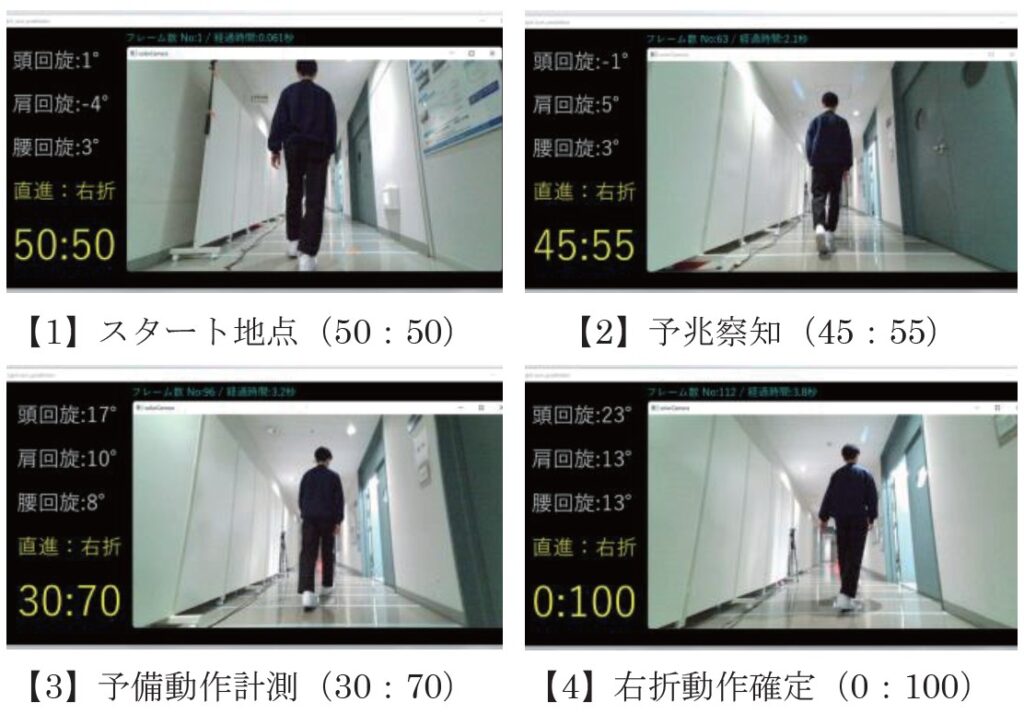
As robots and sensors become increasingly integrated into residential environments, the ability to predict human movement is essential for ensuring both safety and comfort. Among the activities of daily living subject to measurement, turning movements during gait are particularly challenging — they occur frequently and are associated with an elevated risk of falls.
To address this, we developed a prediction system for gait-based turning movements in real residential settings. By extracting meaningful predictive parameters that reflect anticipatory preparatory motions prior to turning — derived from whole-body joint position data acquired via sensors — we work to improve prediction accuracy while also investigating how spatial characteristics and individual differences affect prediction performance.